DTN News - INDIA TODAY: Goodman The Lalten Lost His Way In Darkness - Manmohan Singh The Incredible Prime Minister of India
*Manmohan Singh a man in shadow, underachiever says Time Magazine.
 Source: DTN News - - This article compiled by Roger Smith from reliable sources Business Line
(NSI News Source Info) TORONTO, Canada - July 8, 2012: The Prime Minister, Dr Manmohan Singh, who has long been lauded for his pivotal role in liberalising the Indian economy, has been dubbed an “underachiever” by a top US magazine which says he appears “unwilling to stick his neck out” on reforms that will put the country back on growth path.
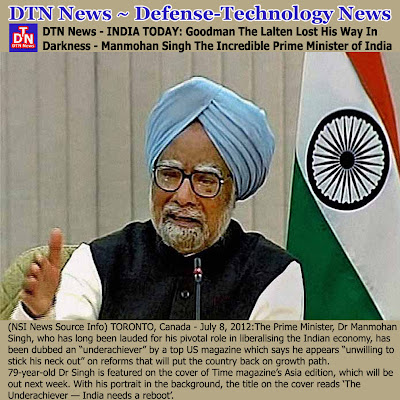 79-year-old Dr Singh is featured on the cover of Time magazine’s Asia edition, which will be out next week. With his portrait in the background, the title on the cover reads ‘The Underachiever — India needs a reboot’.
‘Is Prime Minister Manmohan Singh up to the job?’ Time’s report ‘A Man in Shadow’ asks, adding that apart from facing the challenges of a slowdown in economic growth, huge fiscal deficit and a falling rupee, India’s Congress party-led UPA coalition “has found itself fending off corruption scandals and accused of showing a lack of economic direction.”
”....investors at home and abroad are beginning to get cold feet. Voters too are losing confidence, as rising inflation and a litany of scandals chip away at the government’s credibility,” the magazine said.
Pointing towards Dr Singh’s fall “from grace,” the magazine said, “in the past three years, the calm confidence he (Dr Singh) once radiated has been absent. He seems unable to control his ministers and — his new, temporary portfolio at the Finance Ministry notwithstanding — unwilling to stick his neck out on reforms that will continue the process of liberalisation he helped start.”
The magazine said at a time when India cannot afford a slowdown in economic growth, “laws that could help create growth and jobs are stuck in Parliament, sparking concerns that politicians have lost the plot in their focus on shorter—term, populist measures that will win votes.”
“Now that Singh is interim Finance Minister as well as PM, he has greater scope and a fresh opportunity to turn things around — but it’s by no means certain that he can,” Time said.
Over the past 20 years, Dr Singh’s “avuncular visage and signature powder blue turban were synonymous with India’s rising star, a fixture on front pages since the early 1990s, when, as Finance Minister, he played a pivotal role in liberalising the economy and setting the nation on the path of fast growth,” the magazine said.
It said in a national capital full of bluster and backroom deals, the quiet economist has long been admired for his restraint and personal integrity. The country clocked a 9.6 per cent growth in his first term as Prime Minister.
“For the past two years, the Congress-led coalition has found itself fending off scandals, most notably the corrupt awarding of 2G spectrum at prices below market value,” the magazine said.
It added that Dr Singh’s “squeaky-clean image” took a hit when anti-corruption crusader Anna Hazare levelled charges at Dr Singh and more than a dozen of his ministers over the alleged misallocation of coal-mining rights.
India’s “battered economy” is another menacing concern for Dr Singh, Time said.
“In a bid to cushion the pain of inflation and keep constituents happy ahead of ever looming elections, the UPA has been burning through its boom—time chests, spending on subsidies and social benefits. But business-friendly laws that could spur growth to offset that spending are languishing, and industry is struggling,” it said.
Given the bleak economic situation, industry leaders are demanding a host of bold reforms, such as an end to expensive subsidies, deregulation of diesel prices and resumption of a law to allow multi-brand retailers like Walmart into India, the magazine said.
Dr Singh has said that the government owes it to the country to take all the “necessary decisions which would return the country to a high—growth path,” it said.
Time said Dr Singh has joined the public soul-searching belatedly, and the electorate will let him know what it thinks of his performance in general elections scheduled for 2014.
”...India can only wait to see if Singh can rouse himself, let alone prevail or overcome,” it said.
The magazine said some believe Dr Singh’s “unofficial power—sharing agreement” with UPA Chairperson Sonia Gandhi has “tied his hands and that he lacks the clout to go against other party stalwarts.”
*Link for This article compiled by Roger Smith from reliable sources Business Line
*Speaking Image - Creation of DTN News ~ Defense Technology News
*This article is being posted from Toronto, Canada By DTN News ~ Defense-Technology News Contact:dtnnews@ymail.com
©COPYRIGHT (C) DTN NEWS DEFENSE-TECHNOLOGY NEWS
*Manmohan Singh a man in shadow, underachiever says Time Magazine.
Source: DTN News - - This article compiled by Roger Smith from reliable sources Business Line(NSI News Source Info) TORONTO, Canada - July 8, 2012: The Prime Minister, Dr Manmohan Singh, who has long been lauded for his pivotal role in liberalising the Indian economy, has been dubbed an “underachiever” by a top US magazine which says he appears “unwilling to stick his neck out” on reforms that will put the country back on growth path.

‘Is Prime Minister Manmohan Singh up to the job?’ Time’s report ‘A Man in Shadow’ asks, adding that apart from facing the challenges of a slowdown in economic growth, huge fiscal deficit and a falling rupee, India’s Congress party-led UPA coalition “has found itself fending off corruption scandals and accused of showing a lack of economic direction.”
”....investors at home and abroad are beginning to get cold feet. Voters too are losing confidence, as rising inflation and a litany of scandals chip away at the government’s credibility,” the magazine said.
Pointing towards Dr Singh’s fall “from grace,” the magazine said, “in the past three years, the calm confidence he (Dr Singh) once radiated has been absent. He seems unable to control his ministers and — his new, temporary portfolio at the Finance Ministry notwithstanding — unwilling to stick his neck out on reforms that will continue the process of liberalisation he helped start.”
The magazine said at a time when India cannot afford a slowdown in economic growth, “laws that could help create growth and jobs are stuck in Parliament, sparking concerns that politicians have lost the plot in their focus on shorter—term, populist measures that will win votes.”
“Now that Singh is interim Finance Minister as well as PM, he has greater scope and a fresh opportunity to turn things around — but it’s by no means certain that he can,” Time said.
Over the past 20 years, Dr Singh’s “avuncular visage and signature powder blue turban were synonymous with India’s rising star, a fixture on front pages since the early 1990s, when, as Finance Minister, he played a pivotal role in liberalising the economy and setting the nation on the path of fast growth,” the magazine said.
It said in a national capital full of bluster and backroom deals, the quiet economist has long been admired for his restraint and personal integrity. The country clocked a 9.6 per cent growth in his first term as Prime Minister.
“For the past two years, the Congress-led coalition has found itself fending off scandals, most notably the corrupt awarding of 2G spectrum at prices below market value,” the magazine said.
It added that Dr Singh’s “squeaky-clean image” took a hit when anti-corruption crusader Anna Hazare levelled charges at Dr Singh and more than a dozen of his ministers over the alleged misallocation of coal-mining rights.
India’s “battered economy” is another menacing concern for Dr Singh, Time said.
“In a bid to cushion the pain of inflation and keep constituents happy ahead of ever looming elections, the UPA has been burning through its boom—time chests, spending on subsidies and social benefits. But business-friendly laws that could spur growth to offset that spending are languishing, and industry is struggling,” it said.
Given the bleak economic situation, industry leaders are demanding a host of bold reforms, such as an end to expensive subsidies, deregulation of diesel prices and resumption of a law to allow multi-brand retailers like Walmart into India, the magazine said.
Dr Singh has said that the government owes it to the country to take all the “necessary decisions which would return the country to a high—growth path,” it said.
Time said Dr Singh has joined the public soul-searching belatedly, and the electorate will let him know what it thinks of his performance in general elections scheduled for 2014.
”...India can only wait to see if Singh can rouse himself, let alone prevail or overcome,” it said.
The magazine said some believe Dr Singh’s “unofficial power—sharing agreement” with UPA Chairperson Sonia Gandhi has “tied his hands and that he lacks the clout to go against other party stalwarts.”
*Link for This article compiled by Roger Smith from reliable sources Business Line
*Speaking Image - Creation of DTN News ~ Defense Technology News
*This article is being posted from Toronto, Canada By DTN News ~ Defense-Technology News Contact:dtnnews@ymail.com
©COPYRIGHT (C) DTN NEWS DEFENSE-TECHNOLOGY NEWS